
📖 Article Navigation
Quick Verdict: Semrush vs Ahrefs
Both tools are excellent, but the right choice depends on your SEO workflow.
Semrush
Best for All‑in‑One Marketing
Ideal for agencies, content teams, and multi‑channel marketers. Includes PPC, social media, content toolkit, and AI visibility tracking.
Try Semrush Free →Ahrefs
Best for Backlink & Technical SEO
Unmatched backlink index, click‑accurate keyword metrics, and Content Explorer. Perfect for link builders and pure SEO specialists.
Visit Ahrefs →Both?
Use Together
Many professionals use Semrush for reporting and PPC, and Ahrefs for backlink analysis and keyword verification. Complementary strengths.
Compare Pricing ↓Let's be honest upfront: most "Semrush vs Ahrefs" articles give you the same feature checklist regurgitated in a different order, then declare a winner based on who paid them more in affiliate commissions. This one doesn't work that way.
Both tools are genuinely good. Both have real weaknesses. And the honest answer — which most comparisons avoid saying — is that the better tool depends entirely on what kind of SEO work you actually do. After breaking down the real data, the pricing math, and where each tool consistently outperforms the other, you'll be able to make that call for your situation.
The Core Philosophical Difference
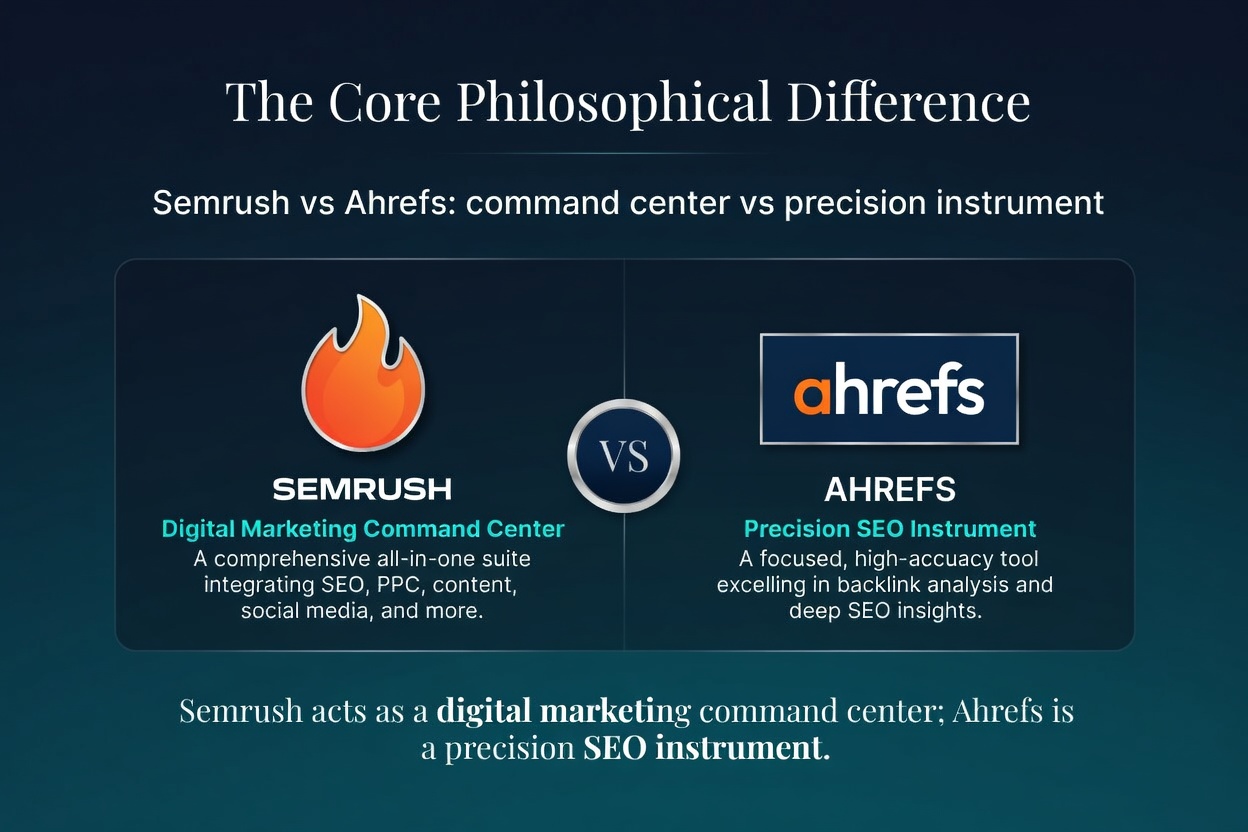
Before getting into individual features, this is the most useful framing for the whole comparison.
The core difference is philosophical: Ahrefs is built as an SEO‑first tool with a surgical focus on backlinks and technical integrity, while Semrush is a broad‑spectrum digital marketing command center that includes PPC, social media, and content tools.
That framing predicts almost everything about which tool wins each category. Ahrefs does fewer things but often does those things better. Semrush covers more ground and is more valuable the more of that ground you actually need. Every decision in this comparison flows from that distinction.
The Database Numbers (And What They Actually Mean)
Both tools have enormous datasets, and they use them to make conflicting claims. Let's put the actual numbers side by side.
- Keyword databases: Semrush tracks 27.9 billion keywords across 142 locations, including 3.8 billion in the USA. Ahrefs has 28.7 billion keywords across 217 locations, but only 2.5 billion in the USA. If you do primarily US‑focused SEO, Semrush's larger US database gives it an edge. For international SEO across many markets, Ahrefs' broader geographic coverage is more useful.
- Backlink databases: Ahrefs maintains the industry's largest index of referring domains at 500 million, compared to Semrush's 390 million. However, Semrush leads in raw backlink count with 43 trillion links versus Ahrefs' 35 trillion. More referring domains matters more for most practical use cases — unique sites linking to you is the signal Google actually cares about. That makes Ahrefs' backlink data stronger for link building.
- Accuracy: Ahrefs relies heavily on clickstream data, making their CTR estimates and clicks‑per‑search metrics highly reliable. Semrush uses a blend of clickstream and machine learning. Multiple 2026 studies show Semrush often has a slight edge in US search volume accuracy, while Ahrefs wins for discovering new backlinks within hours of them going live.
For a deeper dive into Semrush's data capabilities, read our complete Semrush review.
Keyword Research: Who Does It Better?
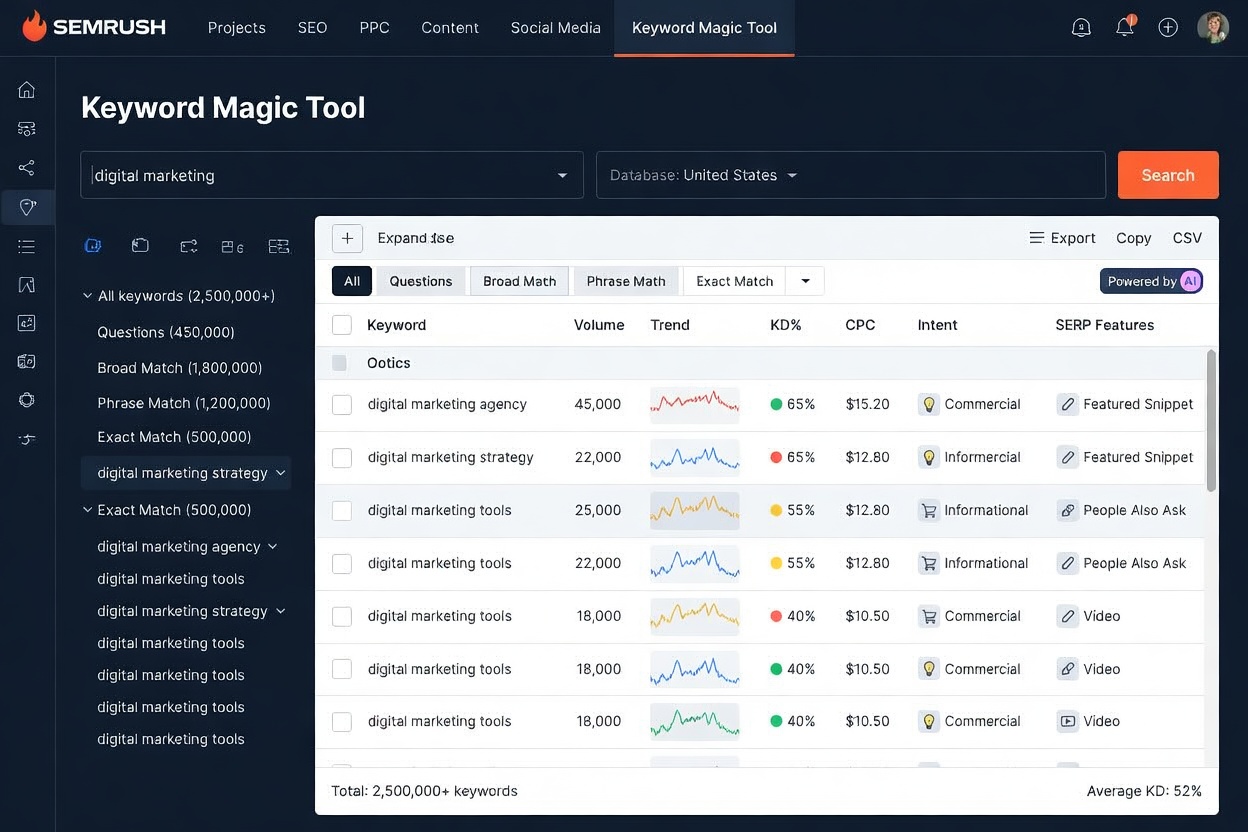
This is genuinely close, and the answer depends on what you're optimizing for.
Semrush's Keyword Magic Tool is the broader research instrument. It generates more keyword variations for a given seed term, surfaces PPC data alongside organic metrics, and includes search intent classification and topic clustering. It's excellent for in‑depth keyword discovery.
Ahrefs' Keyword Explorer has a feature that Semrush still hasn't fully replicated: Traffic Potential — showing not just the search volume of a keyword, but how many visits you'd actually get if you ranked #1 for it, accounting for all the variations people search for. This lets you spot juicy keywords you might otherwise overlook. Ahrefs also accounts for SERP features that steal clicks (knowledge panels, AI Overviews), giving you a more honest view of real‑world clicks.
According to SparkToro's 2026 analysis, zero‑click searches now represent over 60% of Google queries, making Ahrefs' click‑adjusted metrics increasingly valuable.
Verdict: Semrush for volume research, PPC overlap, and US‑focused keyword discovery. Ahrefs for understanding actual traffic potential and click behavior — which matters more as zero‑click searches rise.
Backlink Analysis: Ahrefs Wins, and It's Not Close
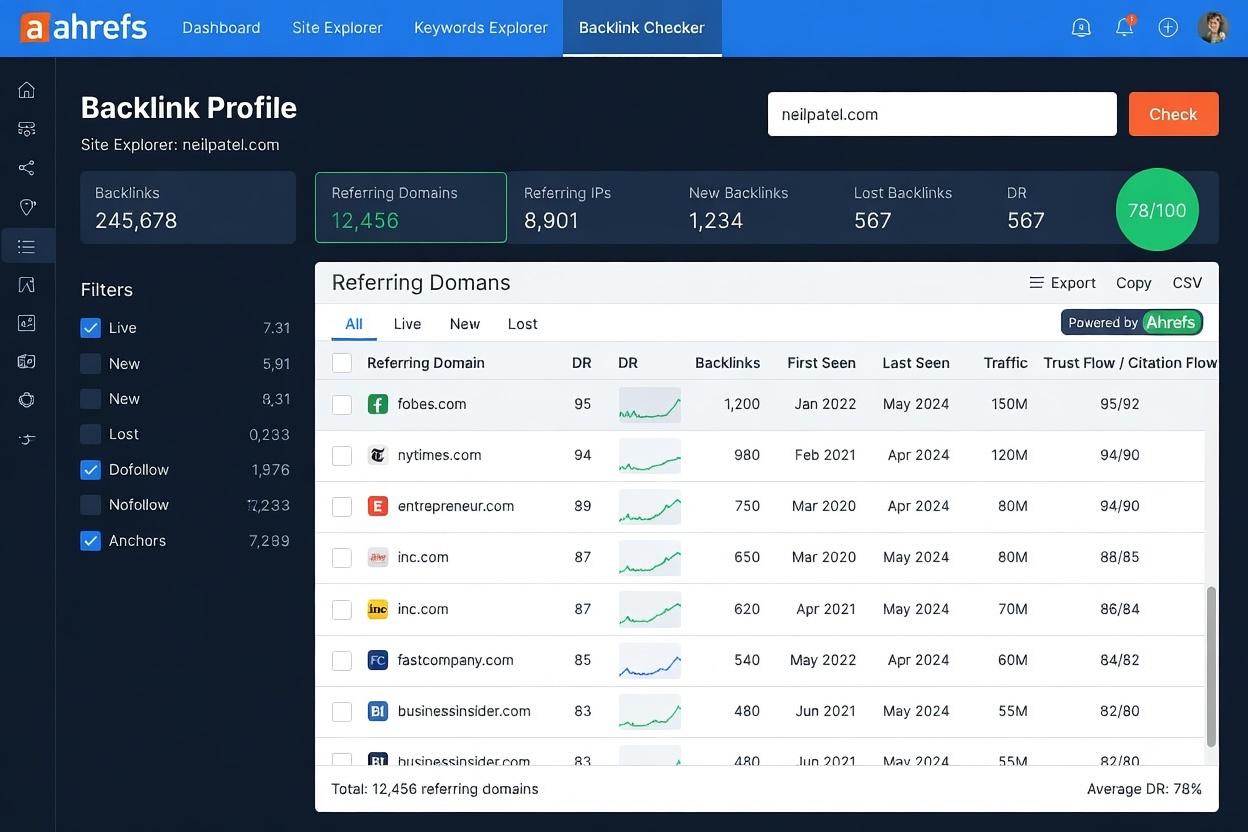
This is where the verdict is clearest. Backlink analysis is where Ahrefs has historically dominated — and the 2026 data confirms that dominance continues. The backlink index is widely considered the gold standard for link accuracy. Ahrefs catches links that Semrush misses for days, and the contextual details help evaluate link quality without guessing.
Ahrefs also provides a cleaner approach to visualizing backlink data, with an intuitive health score prominently displayed and issues presented in a more digestible format — better suited for those newer to technical SEO analysis.
Semrush has improved its backlink tooling significantly, and it provides useful macro views of a site's link profile over time. But for any SEO whose work involves serious link building, competitive link research, or finding broken link building opportunities, Ahrefs' backlink tooling justifies the subscription on its own.
Site Audit & Technical SEO
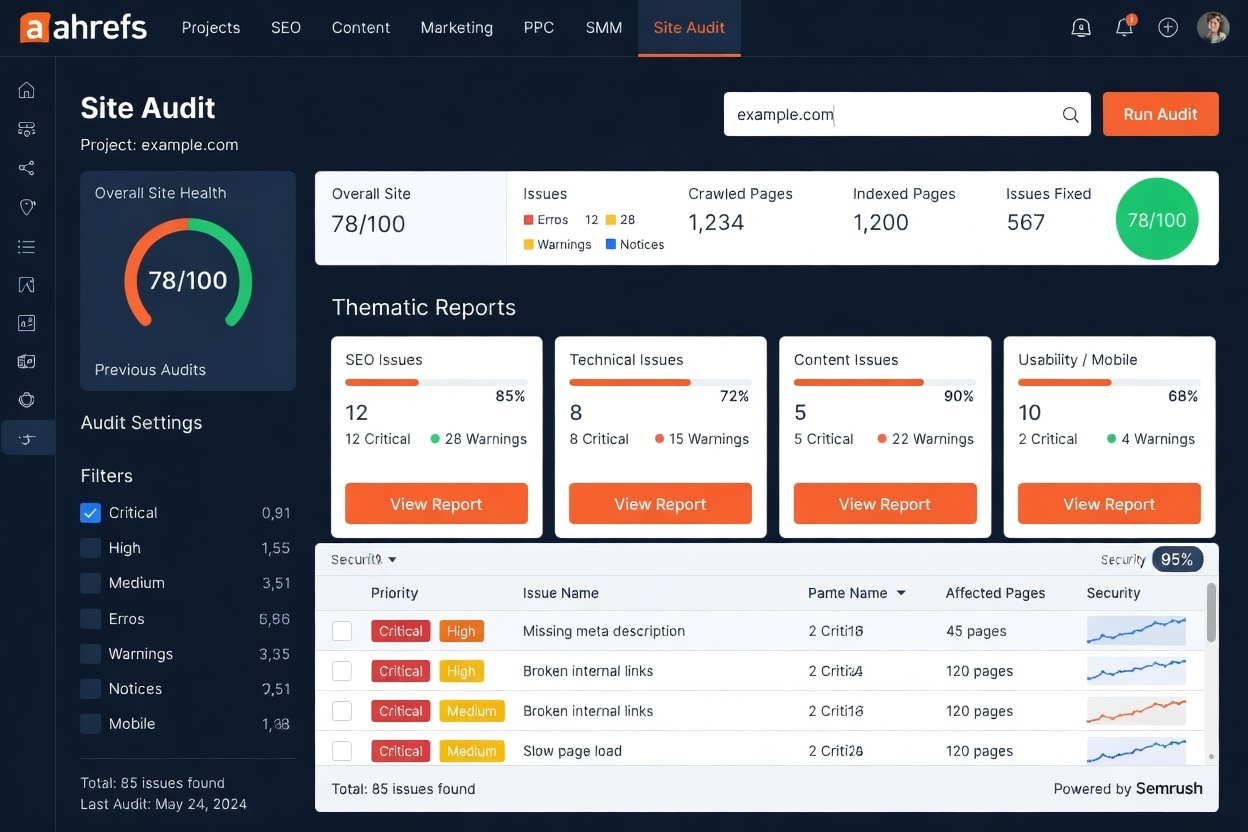
Semrush's Site Audit categorizes issues into Errors, Warnings, and Notices. What distinguishes it is the Thematic Reports feature — organizing issues by crawlability, HTTPS, Core Web Vitals, and internal linking. For large sites with complex technical debt, this organization is essential. Semrush also provides actionable fix recommendations and tracks issues over time.
Ahrefs' Site Audit is cleaner and more approachable for less technical users, but covers the fundamentals well. For the majority of sites — those that don't have 100,000+ pages — both tools handle auditing effectively.
Verdict: Semrush for large, complex sites where detailed categorization and prioritization matter. Ahrefs for simpler audits with a cleaner, faster interface.
The Tools Semrush Has That Ahrefs Doesn't
- Full PPC competitor research and Google Ads management tools
- Social media scheduling and performance tracking
- Content Marketing Toolkit (topic research, SEO writing assistant, content audit)
- AI Visibility Tracking across ChatGPT, Google AI Overviews, and AI Mode (via Semrush One plans)
- White‑label PDF client reports (Guru plan and above)
For agencies managing multiple clients, the Semrush Guru plan's Content Marketing Platform reduces the need for a separate Surfer SEO subscription. Branded PDF reports alone make the plan feel justified when you're billing SEO services.
The Tools Ahrefs Has That Semrush Doesn't Match
- Content Explorer — a billion‑page searchable database of content across the web, filterable by organic traffic, backlinks, social shares, and domain rating. Unmatched for finding link building prospects and identifying content gaps.
- Starter Plan — $29/month (introduced January 2026), cutting the entry price by 70% and opening access to basic keyword research and site audits for bootstrapped users.
Pricing: The Real Side‑by‑Side
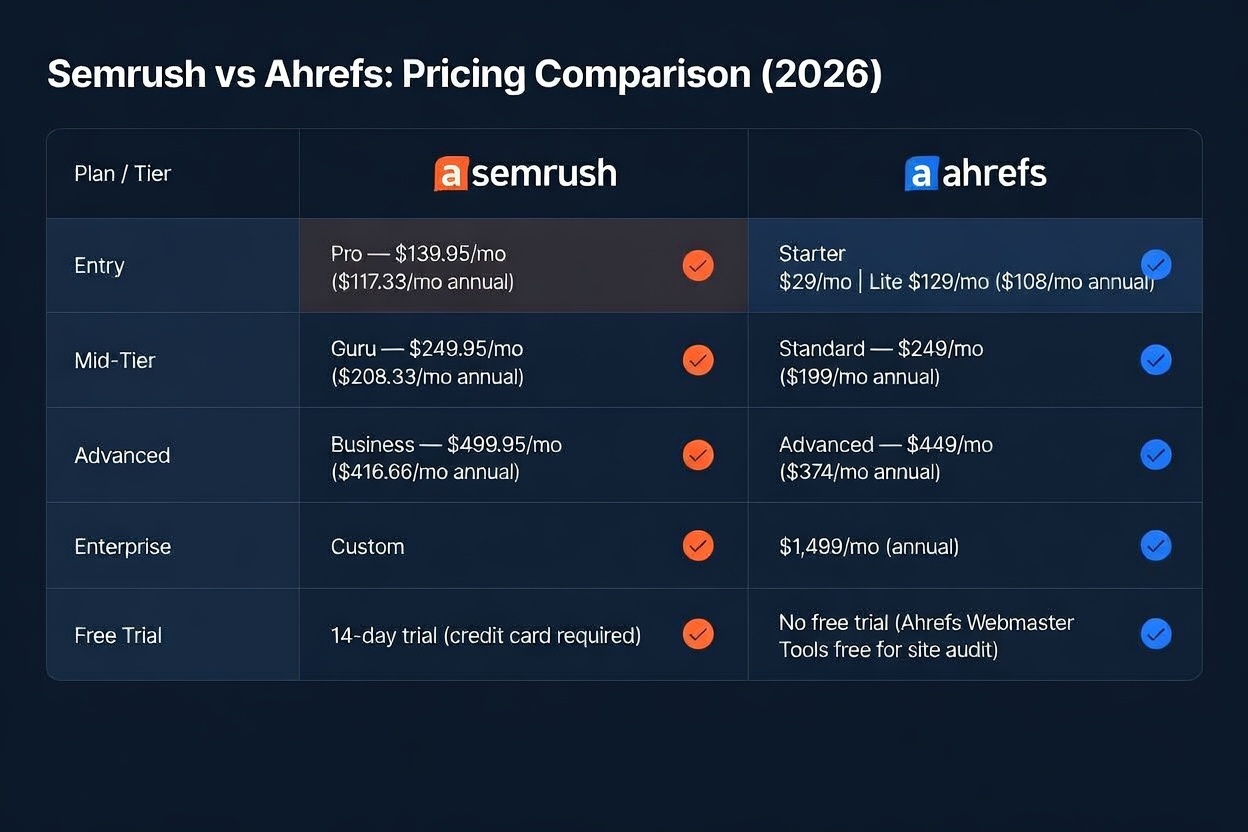
| Plan | Semrush | Ahrefs |
|---|---|---|
| Entry | Pro: $139.95/mo ($117.33 annual) | Starter: $29/mo; Lite: $129/mo ($108 annual) |
| Mid‑Tier | Guru: $249.95/mo ($208.33 annual) | Standard: $249/mo ($199 annual) |
| Advanced | Business: $499.95/mo ($416.66 annual) | Advanced: $449/mo ($374 annual) |
| Enterprise | Custom | $1,499/mo (annual) |
| Free Trial | 14‑day trial (credit card required) | No free trial (Ahrefs Webmaster Tools free for site audit) |
The mid‑tier plans are nearly identically priced — Semrush Guru at $249.95 vs Ahrefs Standard at $249. But what you get differs. Semrush Guru includes the Content Marketing Toolkit, historical data back to 2012, and three user seats. Ahrefs Lite and Standard include only one user seat — additional seats are only available on Advanced at $80/month each, a significant hidden cost for teams.
Ahrefs' credit system is a critical consideration. Lite gives you only 500 Site Explorer and Keywords Explorer searches per month. Power users can burn through 500 in a few intensive days. Once you hit the cap, you're locked out until the next billing cycle. Semrush has no such search limits on its paid plans. For a full breakdown of Semrush costs, see our Semrush pricing guide.
The 2026‑Specific Factor: AI Visibility
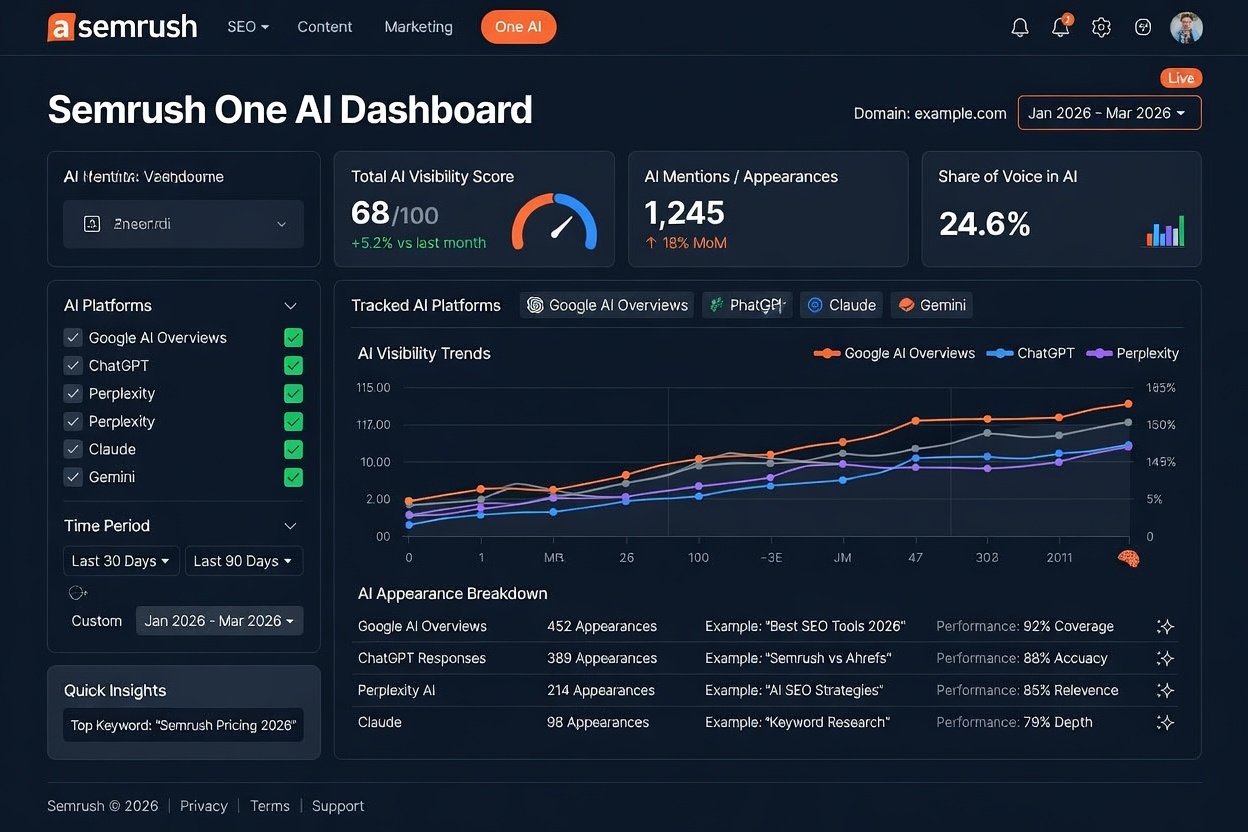
This is a new dimension that didn't exist two years ago. Semrush has moved aggressively with Semrush One — tracking how your brand appears in ChatGPT, Google AI Overviews, and AI Mode. Ahrefs recently introduced an AI SEO feature that shows the number of AI citations on major AI tools like ChatGPT, Gemini, and Perplexity — but you need to pay extra through add‑ons.
As of early 2026, Semrush's AI visibility tooling is more mature, more integrated into the core platform, and — when purchased as Semrush One — more cost‑effective than assembling equivalent Ahrefs add‑ons. For brands where AI search visibility is becoming meaningful, Semrush One is the stronger choice.
✅ Semrush Strengths
- Broader marketing suite (PPC, social, content)
- Larger US keyword database
- AI visibility tracking built‑in
- Three user seats on Guru plan
- White‑label client reports
✅ Ahrefs Strengths
- Superior backlink index and freshness
- Traffic Potential and click‑accurate metrics
- Content Explorer for link prospecting
- Cleaner, faster interface
- $29 Starter plan for beginners
Who Should Use Which Tool
Choose Semrush if: you run a marketing agency managing multiple clients across SEO and PPC; you need content marketing tools and branded client reports; you want AI visibility tracking; you need multiple team members with access (Guru's three included seats are a genuine value); you do primarily US‑focused SEO. Read our full Semrush review for more details.
Choose Ahrefs if: link building is the core of your SEO work; you value click‑accurate keyword metrics that account for zero‑click SERF features; you manage many client websites and need Ahrefs' unlimited verified domain tracking; your work is pure SEO without PPC, social, or content marketing overlap; you want Content Explorer for link prospecting.
Use both if: Many professional SEOs and agencies use both tools. Semrush as the primary campaign management and reporting platform — especially for client reporting, content planning, and PPC research — while using Ahrefs for deep backlink analysis, keyword accuracy verification, and Content Explorer research. The tools are genuinely complementary.
The honest verdict: There isn't a universally better tool. There's the better tool for your workflow. Ahrefs wins on backlink quality, click‑accurate keyword data, Content Explorer, and clean data presentation. Semrush wins on breadth, content marketing integration, PPC tools, US keyword volume, client reporting, AI visibility tracking, and multi‑user value. Identify which camp describes your day‑to‑day work, and you'll have your answer.
Try Semrush Risk‑Free for 14 Days
Get full access to Semrush's keyword research, site audit, content toolkit, and AI visibility features. Compare against Ahrefs yourself with a free trial.
Start Semrush Free Trial →Affiliate disclosure: We may earn a commission at no extra cost to you.
❓ Frequently Asked Questions
📚 More Resources
Full breakdown of plans, hidden costs, and how to save money.
In‑depth analysis of features, pros/cons, and real‑world performance.
How AI‑generated content affects rankings and what works now.
Browse all software reviews and comparisons.
Latest articles and updates.
💎 Transparency Note
Affiliate Disclosure: We use affiliate links in our reviews. If you sign up through our links (like this Semrush free trial link), we may earn a commission at no extra cost to you. This doesn't influence our reviews — we maintain strict editorial independence.