
📖 Article Navigation
SEO & Analytics
Semrush
Best for agencies, in‑house teams, and serious bloggers
Want to Try Our Top Recommendation?
Semrush is powerful, but most beginners get confused by add‑ons and seat costs. We break down exactly which plan saves you money and which one drains it.
- 26B+ keyword database – largest in the industry
- Includes Content Marketing Platform (Guru+)
- AI Visibility Toolkit (Semrush One) tracks ChatGPT
- White‑label reporting & API (Business tier)
Most Semrush pricing articles give you the same table you can find on Semrush's own website, add a few bullet points, and call it a day. That's not what this is.
What nobody warns you about upfront: the plan price is almost never what you actually pay. A team of three on the Guru plan doesn't pay $249.95 a month. They pay closer to $410 — and that's before add-ons. This guide breaks down every number you need before you commit, including the costs buried in the fine print that nobody mentions until your invoice arrives.
The Pricing Structure Has Changed in 2026
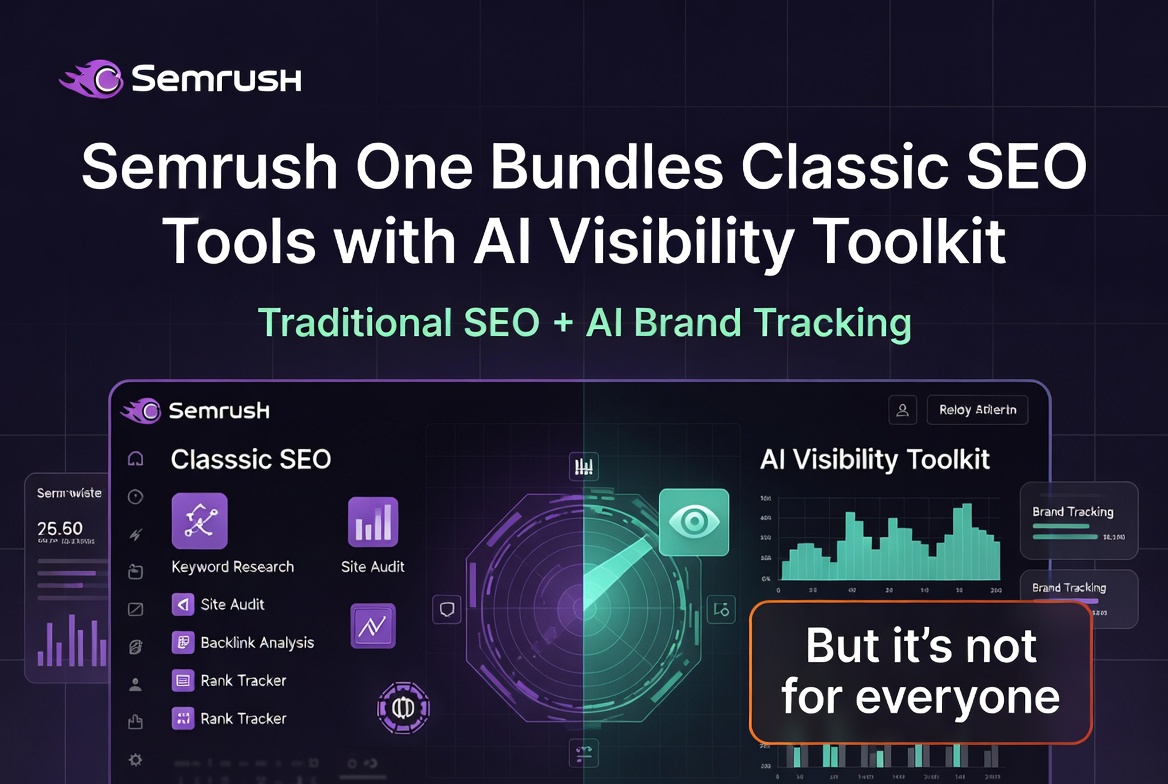
Before getting into specific numbers, there's something important to understand: Semrush significantly restructured its product lineup in late 2025 with the launch of Semrush One — a bundled offering that combines traditional SEO tools with a new AI Visibility Toolkit.
This means there are now effectively two paths:
- Classic SEO Path — the traditional Pro, Guru, and Business plans focused on Google rankings, keyword research, and site audits.
- Semrush One Path — a newer bundle that includes everything in the classic plans plus AI brand visibility tracking across ChatGPT, Google AI Overviews, and AI Mode.
For most of the last decade, Semrush was purely an SEO tool. You paid for keyword data, backlinks, audits, and rank tracking. That worked — until generative AI changed how people discover brands. With tools like ChatGPT, Google Gemini, and Perplexity influencing buying decisions, Semrush adjusted its pricing model. Understanding which path fits your needs determines everything else. Let's break down both.
The Classic SEO Plans: Exact Prices & What You Actually Get
Pro Plan — $139.95/month (or $117.33/month billed annually)
The Pro plan is Semrush's entry-level option, ideal for beginners or small teams with core SEO tools — managing up to 5 projects, tracking up to 500 keywords, and auditing up to 100,000 pages per month. On paper, that sounds solid. In practice, there are two hard limitations that catch people off guard.
First: Pro excludes historical data access — available only in Guru and Business tiers — and the full Content Marketing Toolkit, which also requires a Guru upgrade. These aren't scalability issues — they're binary feature gates. You cannot work around Pro's limitations by managing fewer projects. You simply don't have access.
Second: the Pro plan only includes one user seat by default. Additional users cost $45/month per user on the Pro tier. If two people on your team need access, you're at $184.95/month — not $139.95. That's a 32% jump that most comparison articles don't acknowledge.
Pro is the right pick if: you're a solo freelancer or consultant billing SEO work to clients, or managing a handful of your own sites where you need core keyword research and audit capabilities and won't need historical data.
Guru Plan — $249.95/month (or $208.33/month billed annually)
This is where Semrush becomes a genuinely different tool. Guru unlocks two critical capabilities absent from Pro: historical SEO data back to January 2012 and the full Content Marketing Toolkit.
The historical data access matters more than it sounds. If you're onboarding a new client and need to explain why their traffic dropped eight months ago, Pro leaves you guessing. Guru gives you the actual data. For any agency doing client reporting, this feature alone justifies the upgrade.
Guru is the plan that makes Semrush worth it for agencies. The jump unlocks three critical features: historical data for proving SEO progress over time, the Content Marketing Platform — which includes Topic Research, SEO Content Template, and the SEO Writing Assistant, reducing the need for a separate Surfer SEO subscription — and three user seats, allowing an analyst, strategist, and account manager to share access simultaneously.
That last point is significant. Additional users cost $80/month per user on the Guru tier. But since Guru includes three seats by default, a team of three pays $249.95 instead of $249.95 + $160 in extra seat fees. That's a meaningful built-in value compared to Pro.
Guru is the right pick if: you're running an agency managing 6+ clients, producing regular content, or need to explain SEO trends to stakeholders using historical data.
Business Plan — $499.95/month (or $416.66/month billed annually)
The Business plan is built for large teams and agencies that need the highest limits — tracking up to 5,000 keywords, managing up to 40 projects, API access, Share of Voice tracking, and white-label reporting at scale. The API access is the real unlock here. If your team wants to pipe Semrush data directly into custom dashboards, internal tools, or client reporting systems, Business is the only tier that makes that possible. No API access exists on Pro or Guru — it's exclusively a Business plan feature.
Buyers at this tier frequently negotiate volume-based discounts, particularly when adding user seats or committing to multi-year terms. Prepayment and competitive evaluation are common levers that create pricing flexibility. In other words, if you're at the Business tier, the listed price is a starting point — not a ceiling. Always negotiate before signing.
Semrush One Plans: The AI Visibility Upgrade
Semrush One bundles the classic SEO toolkit with the new AI Visibility Toolkit. The Starter plan runs $199/month, Pro+ is $299/month, and Advanced is $549/month — with enterprise pricing available on request.
The math on whether Semrush One makes sense comes down to one question: do you need to track how your brand appears inside ChatGPT, Google AI Overviews, and AI Mode responses?
More specifically, Semrush One Starter is a bundle of the Semrush Pro plan ($139.95) and the AI Visibility Toolkit ($99 if bought separately, covering 1 domain and 25 daily prompt tracking). So if you were going to buy both anyway, the bundle saves you around $40/month and adds a cleaner unified dashboard.
There's a hidden wrinkle with the AI Visibility Toolkit specifically: adding a team member to access those features costs an additional $99 per user on top of the standard seat fee. Three team members requiring AI Visibility Toolkit access means $297/month in that add-on alone — not the $99/month flat rate the pricing page implies.
Semrush One is the right pick if: your brand or your clients' brands need to be visible in AI-generated answers, not just traditional search results. If you're purely focused on Google rankings and traditional SEO, stick with the classic plans and save the $60/month difference.
The Full Add‑Ons Menu (And What Each Actually Costs)
The most expensive add‑ons that Semrush offers in 2026 include: Local SEO at $30/month, Social Media toolkit at $20/month, Content Toolkit at $60/month, Advertising Toolkit at $99/month, AI Visibility at $99/month, and Traffic & Market Trends at $289/month.
A few things worth knowing about each:
- The Trends Add‑On ($289/month) is the one that surprises people the most. It's genuinely powerful for market research and competitive intelligence — but nearly $300/month on top of your plan is a serious commitment. It only makes sense if you're actively selling market research as part of a service or have enterprise‑level competitive monitoring needs.
- The AI Visibility Toolkit ($99/month) is already bundled into Semrush One plans. If you're on a classic plan and considering adding it, the math may push you toward Semrush One Starter ($199) instead of Pro + AI Visibility addon ($139.95 + $99 = $238.95). The bundle is actually cheaper by $40/month in that scenario.
- The Local SEO Add‑On ($30/month per location) scales per location. A business managing five local storefronts is paying $150/month in local SEO alone on top of their base plan.
The Free Trial: What It Includes and the Catch
Semrush offers a 14‑day free trial giving full access to Pro or Guru features. You need a credit card, and you'll be charged automatically after 14 days if you don't cancel. There is also a free‑forever account, but it is very limited — up to 10 searches per day and tracking for 10 keywords, which is useful for quick checks but not enough for professional SEO work.
The 14‑day trial is genuinely useful if you use it properly. The trap is signing up, spending the first week clicking around without a plan, and then realizing on day 13 that you haven't actually tested the features that matter for your use case. Before you start the trial, write down the three specific things you need to validate — your competitor analysis workflow, the accuracy of keyword volume data for your niche, or how the content audit tool handles your site. Test those specifically.
Also: Semrush offers a 7‑day money‑back guarantee on all new subscriptions if you cancel within the first 7 days. That's separate from the trial and worth knowing if you start a paid plan and immediately realize it's not what you expected.
Semrush vs. Alternatives: Honest Price Comparison
| Tool | Entry Price | Mid‑Tier | Free Plan? |
|---|---|---|---|
| Semrush Pro | $139.95/mo | $249.95/mo (Guru) | No (10 searches/day) |
| Ahrefs Lite | $129/mo | $249/mo (Standard) | No |
| SE Ranking | $65/mo | $119/mo | No |
| Moz Pro | $99/mo | $179/mo | No |
| Mangools | $29.90/mo | $44.90/mo | No |
For budget‑conscious users, Mangools at $29.90/month and SE Ranking at $65/month cover about 80% of Semrush's features at a fraction of the cost. Semrush has a larger keyword database and more marketing tools — but for a single blog or a solo freelancer, those advantages rarely justify the price gap.
The honest take: if you're running an agency with real client retainers and need everything in one place — keyword research, content tools, site audit, competitor intelligence, and branded reports — Semrush Guru is hard to beat on value per feature. If you're a solo blogger or a small business just getting started with SEO, the price gap between Semrush and alternatives is difficult to justify until you're generating meaningful revenue from search.
✅ What Makes Semrush Worth It
- Largest keyword database (26B+)
- All‑in‑one SEO + content + AI visibility
- Three seats included in Guru (huge value)
- White‑label reports & API (Business)
❌ Where Pricing Hurts
- Add‑ons and seat costs add up fast
- No historical data in Pro plan
- AI Visibility Toolkit requires extra $99 or bundle
- Steep learning curve for beginners
How to Actually Reduce Your Semrush Bill
- Pay annually from day one. Annual billing saves 16–17% immediately — roughly two months free across all tiers. There's no reason to pay month‑to‑month unless you're genuinely uncertain you'll continue using it.
- Be strategic about extra seats. Instead of buying a full seat for a writer at $80/month, export content briefs for them or use the Google Docs extension. Keep Semrush access for strategists and analysts who actually need the platform — not every person who touches the content.
- Don't stack add‑ons on day one. Start with the base plan for 30 days and identify which features you're actually using before bolting on toolkits. The Social Media add‑on and Local SEO add‑on are easy to skip initially and add later if you truly need them.
- Negotiate at the Business tier. Actual contract pricing often differs based on user count, contract term, prepayment, and negotiation. Multi‑year commitments, volume‑based pricing, and competitive positioning — mentioning you're also evaluating Ahrefs or Moz — are the most effective levers for securing below‑list pricing.
- Consider Semrush One if you need multiple features. The Semrush One bundles include local SEO and some analytics features that would cost extra individually — meaning the bundle can actually be cheaper than assembling equivalent features from classic plans plus add‑ons.
The Bottom Line: Which Plan for Which Situation
- Solo freelancer or blogger: Classic Pro at $117.33/month (annual). Don't upgrade until you genuinely need historical data or content tools — those are Guru features you can live without while you're getting established.
- Small agency, 3‑person team: Classic Guru at $208.33/month (annual). The three included seats make this a genuine deal, and the Content Marketing Toolkit replaces a separate Surfer SEO or similar subscription.
- Growing agency with a larger team: Classic Guru + calculate your extra seat costs carefully before committing. A team of five pays significantly more than the advertised price.
- Brand‑aware business tracking AI visibility: Semrush One Starter at $199/month. The math works out better than buying Pro + AI Visibility separately, and the unified dashboard is cleaner.
- Enterprise or high‑volume agency: Business tier, but negotiate. The published price is a starting point, not a final offer.
The most important advice: before you sign up for anything, map out the exact features you'll use in the first 90 days. Semrush's pricing is defensible when you're using the platform actively. It gets expensive quickly when you're paying for capabilities that sit unused while you're still figuring out your workflow.
Ready to test the platform? Start your 14‑day free trial here – just remember to cancel before day 14 if you're not convinced.
Try Semrush Risk‑Free for 14 Days
Get full access to Pro or Guru features. Test keyword research, site audits, and content tools – and see exactly which plan fits your budget before you pay.
Start Free Trial →Affiliate links may earn us a commission at no extra cost to you.
❓ Frequently Asked Questions
📚 More Resources
Curated shortlist of top SEO, marketing, and analytics software.
Complete feature analysis, pros/cons, and real‑world testing.
Head‑to‑head comparison of features, pricing, and value.
Does AI content rank? Data‑driven answer.
Why your pages aren't showing up – and how to fix it.
How zero‑click search and AI Overviews changed SEO.
Browse all software reviews and guides.
Latest articles and updates.
💎 Transparency Note
Affiliate Disclosure: This article contains affiliate links. If you sign up through our links (like this free trial link), we may earn a commission at no extra cost to you. This does not influence our recommendations — we maintain strict editorial independence and test every tool independently.