
📖 Article Navigation
The Best Tool to Audit Your Content Quality & AI Visibility
Most SEO tools just show rankings. Semrush shows you whether your content is actually helpful – and where AI Overviews are citing your pages (or your competitors').

Semrush
Best for content teams who use AI responsibly
Semrush's Content Audit and AI Visibility Toolkits help you identify thin content, track AI citations, and measure whether your human expertise is cutting through. Used by top publishers to avoid Google penalties.
- ✔ Content Audit – find low‑value pages before Google does
- ✔ AI Overview tracking – see if your content gets cited
- ✔ Competitor content gap analysis
- ✔ Keyword Magic with intent and question data
Every week, someone publishes a post claiming AI content is dead in Google's eyes. The next week, someone else publishes a case study showing their AI-written blog climbed to page one in three months. Both things are true — and that contradiction is exactly why this conversation is so confusing.
Let's cut through the noise with actual data, real examples, and some honest context about what's changed, what hasn't, and what the nuance everyone keeps skipping actually means.
First, What Google Actually Says (And Means)
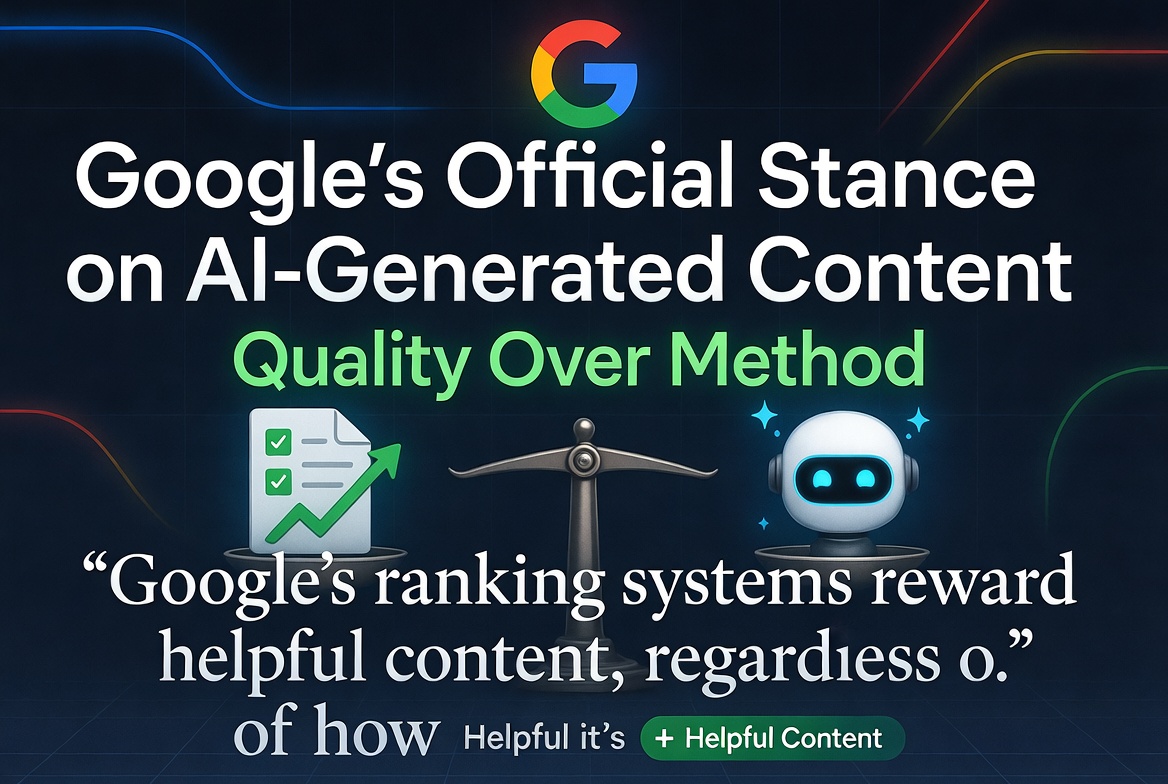
Google's official position has been consistent since 2023 and remains unchanged in 2026: their ranking systems don't penalize AI-generated content — they penalize low-quality content. Using automation to generate content with the primary purpose of manipulating ranking in search results is a violation of spam policies. Using it to genuinely help users is not.
That sentence sounds simple. Most people read it and think "great, I can use AI freely." But there's a crucial word buried in there — primary purpose. Google isn't judging your tool. It's judging your intent and the resulting quality. Those are very different things.
The practical translation: Google has built systems to detect when AI is being used at scale to flood the index with thin content, not to determine whether a specific paragraph was written by a human or a machine.
What the Data Actually Shows About AI Content Rankings
Here's where things get genuinely interesting.
Ahrefs analyzed 600,000 top-ranking pages and ran each one through an AI content detector. Human-written content made up only 13.5% of the top 20 ranking pages. The correlation between AI content percentage and search ranking position across the entire dataset was 0.011 — effectively zero.
Read that again. 86.5% of top-ranking pages already use AI assistance to some degree, and there's no statistical relationship between AI content levels and where a page ranks. That's not a minor finding. That's the data fundamentally dismantling the premise that AI content can't rank.
A separate Semrush analysis of 20,000 blog URLs confirmed it: 57% of the AI content analyzed ended up in the top 10 results, versus 58% for human-written content — effectively the same likelihood of ranking on page one.
So why are people still losing traffic to Google updates? Because there's a critical difference between AI content that ranks and AI content that gets wiped out — and it has nothing to do with the tool used to produce it.
The Real Divide: AI as a Tool vs. AI as a Shortcut
This is the insight most articles dance around but never say plainly.
AI content fails when it's used as a replacement for thinking. AI content succeeds when it's used as an accelerator for expertise.
The distinction matters enormously in practice. When a content farm uses AI to produce 200 thin "what is X" articles in a week with no human review, no original angle, and no expertise behind them — those articles are junk, and Google's systems are increasingly good at identifying that pattern. It's not the AI that makes them junk. It's the absence of any real value.
When a subject-matter expert uses AI to draft a framework, then rewrites it with firsthand experience, adds original data, and structures it for genuine usefulness — that article can and does rank. The AI sped up the process. The human made it worth reading.
Ross Simmonds, CEO of Foundation Marketing, put it this way: "I leverage AI in different ways over the course of the day, but I wouldn't consider the content I create to be AI-generated. I'd consider it augmented with AI — much like a blog post or book I write would be enhanced by spell check."
That framing — augmented vs. generated — is the most useful mental model for this debate.
What Google Has Actually Penalized (With Real Examples)
The March 2024 core update is the most significant reference point in this conversation, and most summaries of it miss the actual lesson.
The March 2024 core update was Google's biggest algorithm change ever — taking 45 days to roll out, changing multiple systems simultaneously, and reducing low-quality content by 40% across the index.
But here's what often gets missed: it wasn't an "AI content update." It was a scaled content abuse update. Scaled content abuse, as Google defines it, refers to very large volumes of low-value pages primarily created with the sole goal of ranking in search. Critically, this also targets human-created content in much the same way if it's mass produced, of low value, and only has the goal of ranking.
The pattern that got sites penalized wasn't "used AI." It was "published at industrial scale with zero oversight."
Sites that received "Pure Spam" notifications in Search Console after the March 2024 update showed a consistent pattern: mass-produced thin product roundups, auto-generated coupons, and templated content produced without meaningful editorial review — entire domains fully deindexed when AI was used for pure volume without governance.
The August 2025 spam update reinforced this further, specifically targeting scaled templates, near-duplicates, and third-party placements on domains — requiring sites to remove or rebuild thin content clusters and improve authorship signals.
The lesson isn't "don't use AI." It's "don't publish garbage at scale."
The 16-Month Experiment That Proves the Nuance
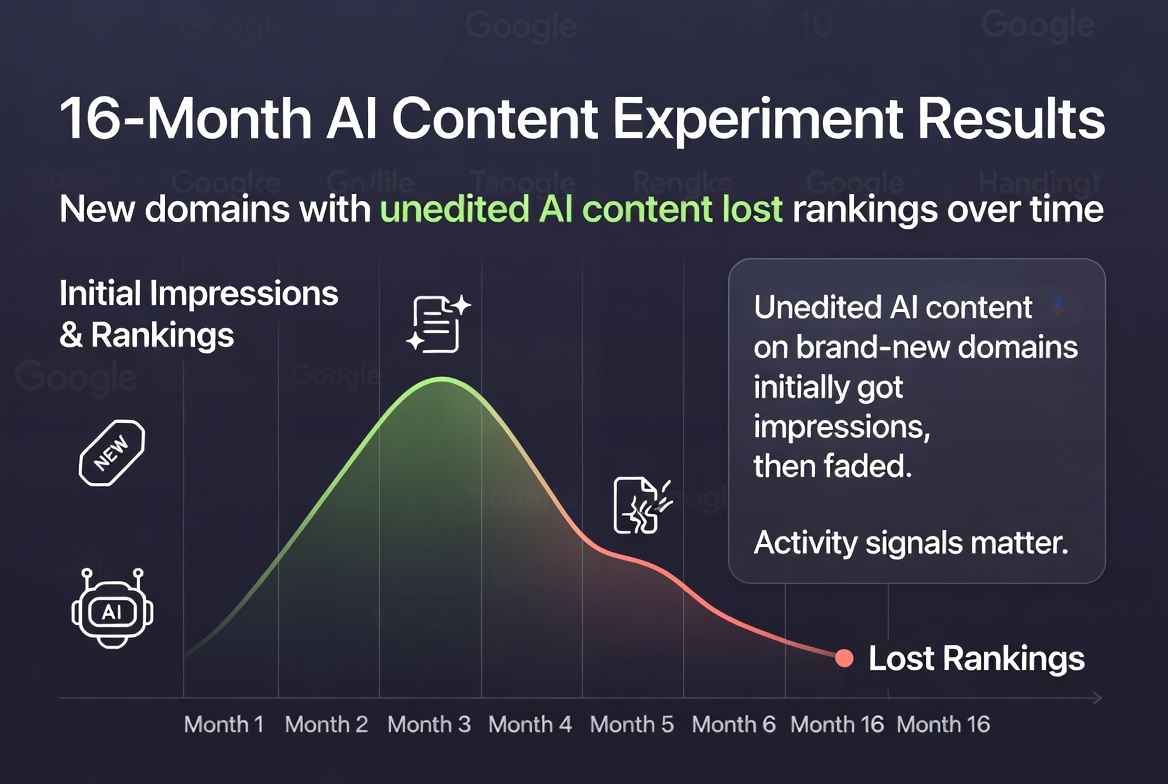
The most honest data point in this whole debate comes from an SE Ranking experiment that ran for 16 months on brand-new domains.
Their research team purchased 20 new domains with no backlinks, domain authority, brand recognition, or search history — each focused on a different niche. Each site received 100 AI-generated articles with no human editing, rewriting, or enhancement, totaling 2,000 pieces across the experiment.
The results were instructive. Early on, many of the pages got indexed and picked up impressions. Then, over time, rankings dropped. The content lacked the signals Google uses to assess quality and trust: no backlinks or external validation, no authors or credentials, no unique insights, no internal linking or topical organization.
But the really interesting finding came in March 2026, when they ran a follow-up: adding new AI-generated content to eight tracked sites produced a science-focused website going from 34 impressions in February to 633 impressions in March — a 19x increase. This suggests that publishing new content, even fully AI-generated, can lift traffic to older pages by signaling the site is active and up to date.
The interpretation matters: AI content alone on a thin site with no authority will eventually stall. But AI content added to an existing site that's showing regular activity can still boost performance. The variable isn't the AI — it's the site's overall health and authority signals surrounding it.
✅ What Works for AI-Assisted SEO
- Human‑augmented content with original insights
- Author bios, credentials, and case studies
- Regular publishing cadence (not sudden spikes)
- Content audits and pruning of low‑value pages
❌ What Triggers Penalties
- Mass‑produced, unedited AI articles at scale
- No human review, no original data, no expertise
- Sudden bursts of publication volume
- Thin, duplicate, or templated content
What Actually Works for SEO Content in 2026
- Lead with your experience, not the topic. Before you write anything, ask: what do I know about this that isn't already on the first page of Google? If the answer is nothing, you're about to write content that AI can already replicate better than you can. Find the angle that's yours.
- Publish at a sustainable pace, not an industrial one. Avoid sudden spikes in content publication — publishing 10 pages this month, 20 the next, and 40 the following month is a safer pattern. Sudden bursts of scale are one of the triggers Google's spam systems are specifically designed to detect.
- Add structured proof to every important claim. Author bios, credentials, data citations, original screenshots, firsthand case study details — these are the signals that separate authoritative content from AI-generated filler. For AI content specifically, E-E-A-T means adding personal insights, citing authoritative sources, and ensuring accuracy through human oversight.
- Audit before you scale. Audit content ruthlessly. Delete, merge, or overhaul pages that no longer serve a purpose. Pruning thin content is just as important as creating new content. Publishing new AI content on top of a site full of weak existing pages is a fast way to trigger quality signals that hurt your whole domain. Our guide to Google indexing issues covers how crawl budget and thin content interact.
- Structure for extraction, not just reading. AI systems don't "read" — they extract. Your content must include question-based headings, clear formatting, and structured answers. The easier your content is to scan, the easier it is for AI to reuse it — and that visibility in AI Overviews is increasingly where the real reach lives. Learn more about AI Overviews and zero‑click search.
The Uncomfortable Insight Nobody Wants to Say Out Loud
Here it is: most of the sites that got wrecked by Google's AI content updates didn't lose because they used AI. They lost because AI made it easy to publish at a volume they couldn't have reached before — and that volume revealed, at scale, that their content had never been particularly good to begin with.
AI removed the friction that used to act as a quality filter. When writing 50 articles a month required 50 hours of effort, most people defaulted to only publishing when they had something worth saying. When AI made it possible to produce 50 articles in 5 hours, the effort barrier disappeared — and so did the natural quality check that came with it.
The solution isn't to avoid AI. The solution is to deliberately build back in the quality check that effort used to enforce automatically: human review, original thinking, genuine expertise, and the honest question — does this add anything that didn't exist before I wrote it?
If the answer is yes, it doesn't matter how much AI helped you get there.
If the answer is no, it doesn't matter how human the writing sounds.
The Bottom Line
Search engines don't penalize AI content — they penalize low-quality content. AI is simply a tool. The difference lies in how you leverage it. When used responsibly, AI can help you create high-ranking content that's valuable for both your readers and search engines.
The sites thriving in 2026 aren't the ones who avoided AI or the ones who went all-in on it. They're the ones who understood that the tool was never the variable. The quality of thinking behind the content always was — and still is.
To track whether your content is truly helpful, Semrush provides the most comprehensive content audit and AI visibility tools. Start with a free trial and see where your content actually stands.
Audit Your Content Quality with Semrush
Stop guessing whether your AI‑assisted content will rank. Semrush's Content Audit shows you exactly which pages are thin, duplicate, or low‑value – before Google decides for you.
Try Semrush Free →Affiliate disclosure: We may earn a commission at no extra cost to you.
❓ Frequently Asked Questions
📚 More Resources
Complete SEO platform analysis – including content audit and AI visibility tools.
Why your content isn't showing up – crawl budget, orphaned pages, and fixes.
How AI Overviews and zero‑click search are changing the game.
Browse all software reviews and guides.
Latest articles and updates.
💎 Transparency Note
Affiliate Disclosure: We use affiliate links in our reviews. If you sign up through our links (like this Semrush free trial link), we may earn a commission at no extra cost to you. This doesn't influence our reviews — we maintain strict editorial independence.